
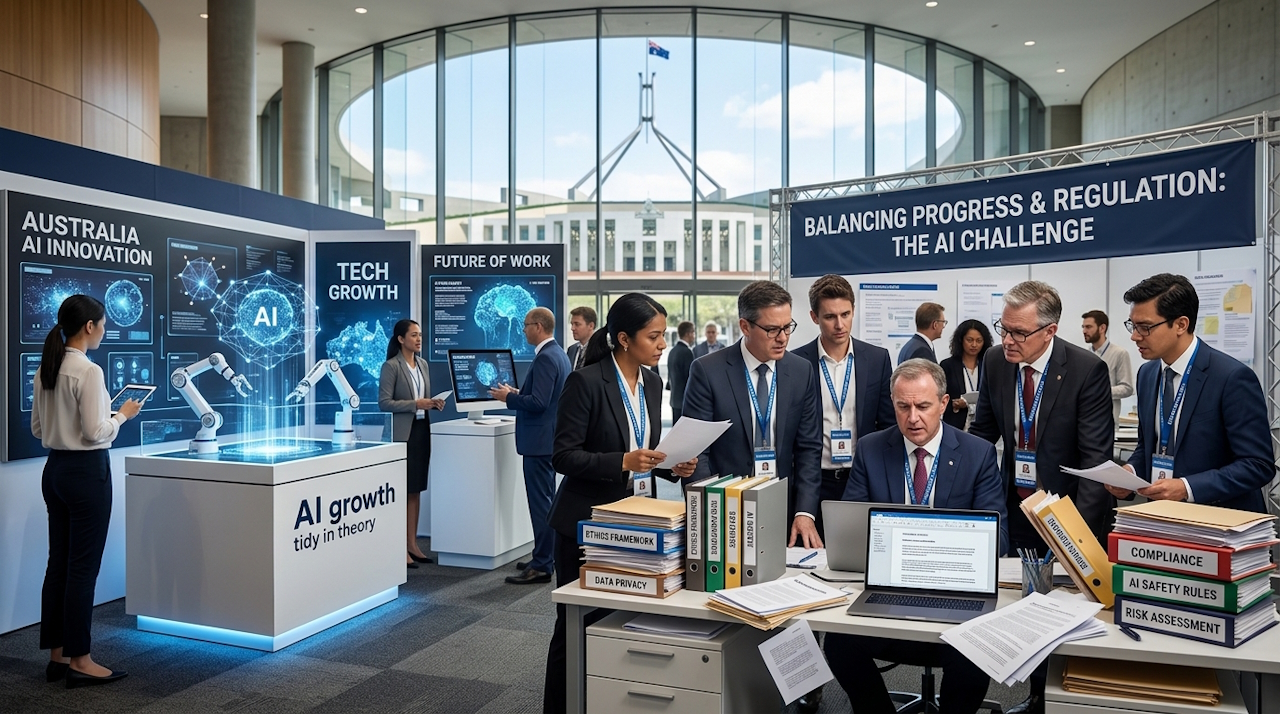

Canberra is trying to back AI growth without letting the rules slip, which is tidy in theory and messy in practice.
The Albanese government is trying to position Australia as a plausible home for artificial intelligence: politically stable, rich in energy and land, and close enough to Asia to matter. The framing, as set out in the ABC’s report on Canberra’s AI push, is that Australia should not just consume AI products built elsewhere but host infrastructure, develop talent and shape at least some of the rules.
That ambition fits a broader policy pattern. The Commonwealth has spent the past two years describing AI as a potential productivity tool while also warning that poorly deployed systems can deepen bias, entrench market power and create new security problems. In practical terms, that means trying to attract investment into data centres, cloud capacity and advanced computing, while keeping one hand on regulatory settings that are still evolving.
The tension is obvious. Ministers want Australia to be seen as open for AI business, but not as a lightly regulated outpost. They also want to avoid the opposite problem: setting rules so uncertain or cumbersome that major developers and infrastructure investors choose Singapore, the United States or the Middle East instead.
Data centres at the centre
The immediate policy focus is not abstract AI leadership so much as the physical machinery that makes modern AI possible. Large models require vast computing power, and that means data centres, power connections, water, fibre and specialist chips. The ABC report points to government interest in attracting that sort of investment, including engagement with overseas AI firms and infrastructure backers.
That emphasis is unsurprising. Policy discussions, including work linked to the National AI Centre, frame the opportunity as extending beyond software start-ups; it also includes the deployment environment around them, from energy-intensive computing to sector-specific applications in mining, healthcare, agriculture and logistics.
But the infrastructure case is complicated by economics and geography. Australia has advantages in renewable energy potential and institutional stability, yet data centres require reliable electricity and often cluster near major cities where grid constraints and land costs are more pronounced. The Australian Energy Market Operator’s planning documents and market updates have highlighted pressure points in transmission and generation as the energy system transitions. AI infrastructure could add another source of demand as the grid is already under strain.
There is also a sovereign capability argument. Governments in many countries are increasingly concerned about where strategically significant computing sits, who controls it, and under what legal regime it operates. Canberra’s interest in domestic capacity reflects not just commercial hopes but also concern that too much dependence on offshore computing could leave Australia exposed in a crisis or paying a premium for access to essential digital infrastructure.
Regulation without a hard stop
For all the rhetoric about innovation, the federal government has not abandoned the case for guardrails. In 2024, the Department of Industry, Science and Resources released proposals for mandatory guardrails for AI in high-risk settings: proposals paper, arguing that voluntary principles may not be enough where AI materially affects rights, safety or access to essential services. The paper proposed obligations around testing, transparency, accountability and human oversight.
That followed the government’s interim response to the Safe and Responsible AI in Australia consultation, which accepted that Australia’s existing laws only partly cover AI harms. Consumer law, privacy law, anti-discrimination law and sector-specific regulation still matter, but ministers have increasingly suggested that general-purpose AI and high-risk uses may need more direct governance.
The challenge is that light-touch and effective are not the same thing. Technology firms often warn against rules that freeze innovation or duplicate overseas compliance burdens. Civil society groups and some academics, by contrast, argue that Australia is behind the European Union in turning broad ethical principles into enforceable obligations. The European Union’s AI Act is often used as a benchmark in these debates, even by countries that do not intend to copy it outright.
Canberra appears to be looking for a middle path: enough certainty to reassure the public and trading partners, but not a fully prescriptive regime that materially slows local deployment. Whether that middle path is durable may depend on what kinds of failures the public sees next. A benign productivity story may favour industry-friendly settings; a scandal involving biased hiring tools, deepfake fraud or unsafe automated decision-making could sharpen the appetite for harder rules.
The Anthropic signal
One of the more revealing features of the current moment is Canberra’s interest in talking to the companies building frontier models, not just local software users. The ABC report notes planned engagement with Anthropic, the US-based AI company behind the Claude family of models, as part of a wider discussion about what role Australia might play in the next phase of AI development and hosting.
That matters because firms such as Anthropic, OpenAI, Google and Meta now sit at the junction of commercial competition and public policy. They are not merely vendors. Their choices about model access, safety testing, data use, content controls and enterprise pricing can shape what entire sectors are able to do. When governments court them, they are effectively courting an ecosystem: cloud providers, chip suppliers, university researchers, start-ups and large enterprise customers.
Still, there is a risk in reading too much into any one company conversation. Australia is an attractive market in some respects, but it is not a top-tier population centre on the scale of the United States, European Union or India, and it does not manufacture advanced semiconductors at scale. The stronger case for Australia is likely to be as a regional deployment and governance hub with specialised strengths, rather than as the unquestioned global centre of frontier model development.
Energy, water and the practical politics
The clean, futuristic language around AI can obscure the old-fashioned politics underneath. Data centres are industrial assets. They need planning approvals, transmission capacity, cooling and community acceptance. In a country already debating housing, transmission lines, renewable projects and water use, AI infrastructure is likely to collide with local priorities.
The CSIRO’s work on Australia’s digital and energy transition has underscored that digital growth is tied to physical systems, especially electricity. If AI drives another surge in hyperscale computing, questions about where power comes from and who pays for network upgrades are likely to move from specialist circles into mainstream politics.
That is one reason the government’s AI message has to be carefully calibrated. Opportunity is easier to sell than more giant industrial buildings consuming large amounts of power. Ministers can argue, with some justification, that AI-enabled infrastructure could support jobs, tax revenue and domestic capability. Critics can reply, also with some justification, that public resources should not be directed too far towards private platforms unless there are clear local spillovers and robust safeguards.
Those debates may become sharper in 2026, not calmer. As of this moment, AI policy is moving quickly globally, but many of the concrete bottlenecks remain local.
Trust is the real constraint
For all the emphasis on investment and competitiveness, the limiting factor may turn out to be public trust. The Office of the Australian Information Commissioner’s guidance on privacy and AI states that AI systems can raise serious questions about data collection, lawful use, explainability and accountability. If the public comes to believe that AI means opaque decisions and weaker privacy protections, broader strategy will probably face resistance.
The same applies to work. The Productivity Commission’s research on digital technology and productivity suggests that the gains from new technology can be real but uneven. AI may boost efficiency, but it may also redistribute power inside workplaces, deskill some roles and increase surveillance. Governments that talk mostly about national opportunity while saying little about labour-market adjustment risk sounding detached from the people expected to absorb the disruption.
That is why Canberra’s balancing act is harder than it first appears. This is not just a matter of choosing between innovation and regulation. It is also about sequencing: how fast to encourage deployment, when to compel testing and disclosure, and how to ensure that infrastructure and market concentration do not lock in problems before the public fully understands them.
A narrow path
Australia’s AI debate is now entering a more practical phase. The easy part was endorsing the technology in principle. The harder part is deciding where to host it, how to power it, who oversees it and which risks justify intervention before damage is obvious.
The government’s instinct — to chase investment while signalling responsible use — is politically understandable and perhaps unavoidable. But it is a narrow path. If Canberra leans too far towards promotion, it will be accused of waving through a powerful technology with patchy safeguards. If it leans too far towards caution, it may watch capital, talent and strategic influence flow elsewhere.
For now, the official bet is that Australia can be both credible and competitive. The next test is whether that claim survives contact with the grid, the law and the public.