
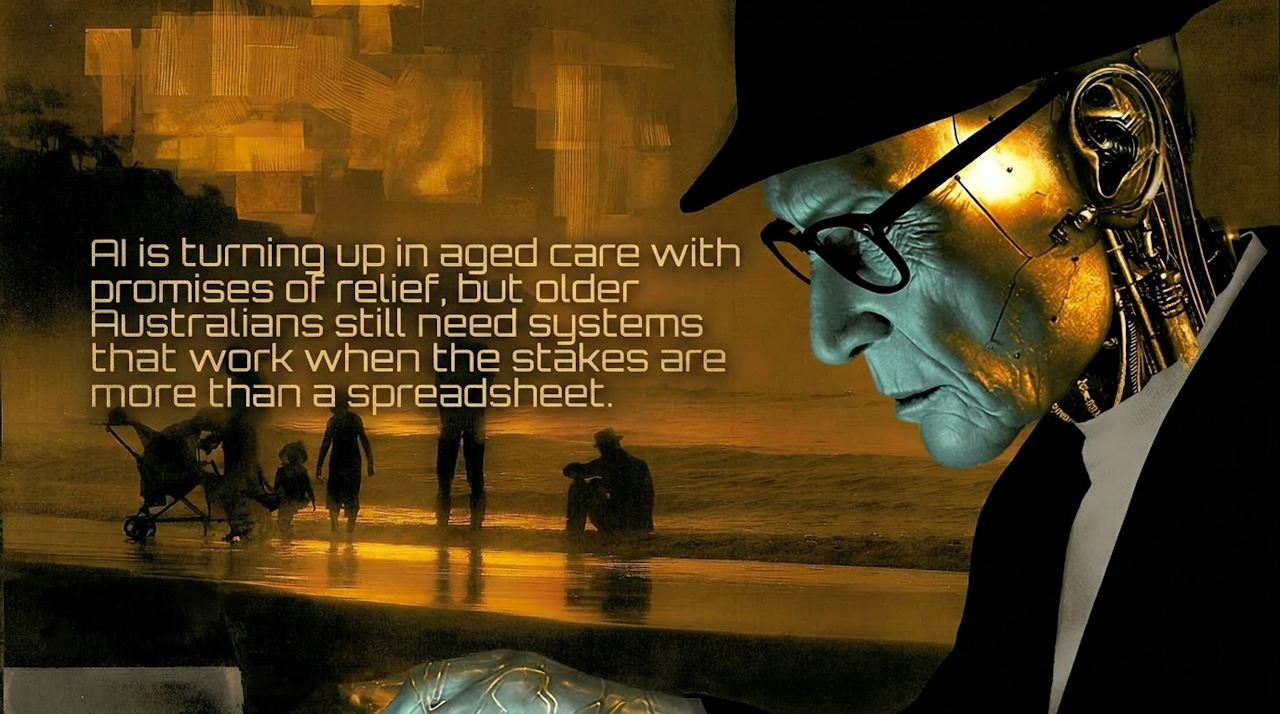

Australia’s aged care sector is under pressure from several directions at once: rising demand, workforce shortages, heavier compliance, and the long tail of reforms following the Royal Commission into Aged Care Quality and Safety. Into that mix comes artificial intelligence, which is being promoted as a way to reduce paperwork, identify risks and help providers use limited staff time more efficiently.
That promise helps explain why the technology is spreading beyond pilot projects. Reporting from ABC News on AI’s growing role in Australian aged care describes a sector where AI tools are being used for tasks ranging from rostering and documentation to falls monitoring and operational forecasting. Some providers and vendors say these systems can return time to nurses and care workers by automating administrative work.
The broader policy environment also favours greater digital uptake. The Department of Health, Disability and Ageing’s aged care reform program has pushed providers towards stronger reporting, governance and data handling. Meanwhile, some industry bodies and researchers have argued that digital tools are likely to be part of how Australia responds to a growing older population without a matching increase in workforce supply.
That does not mean AI is arriving in a vacuum. It is entering one of the country’s most scrutinised human services, where errors can affect medication, mobility, nutrition, privacy and dignity. In aged care, efficiency is only useful if it improves care rather than merely measuring it.
The most plausible use cases
The least controversial AI applications are generally the ones furthest from direct care decisions. Providers are using or testing software to summarise case notes, transcribe handovers, flag missed documentation, optimise staffing patterns, detect anomalies in incident logs and support maintenance planning. These uses sit closer to workflow support than bedside judgement.
There is also growing interest in monitoring tools. Depending on the setting, these can include sensors that detect movement patterns, systems designed to alert staff to a possible fall, and predictive tools that claim to identify residents at higher risk of deterioration. Internationally, the World Health Organization’s guidance on ethics and governance of AI for health notes that such tools can improve responsiveness, but only if they are carefully validated and deployed with meaningful human oversight.
Another possible growth area is communication support. AI-assisted translation, speech-to-text and simplified written summaries could help workers, residents and families navigate care plans and service information more easily, particularly in culturally and linguistically diverse settings. Used well, those tools could improve access rather than simply cut costs.
Still, providers should be wary of inflated claims. The CSIRO’s work on responsible AI adoption in Australia stresses that AI systems are not magic; they depend on data quality, fit-for-purpose design and governance. In aged care, poor notes, inconsistent records or biased historical practices can all be reflected in the output.
Efficiency is not the same as care
One of the central risks in aged care is that AI tools are sold as labour-saving devices in a system where personal interaction is already stretched. If software reduces repetitive administration and gives carers more time with residents, that is one thing. If it becomes an excuse to further reduce staffing or replace judgement with dashboards, that is another.
This is where the sector’s history matters. The Royal Commission into Aged Care Quality and Safety’s final report documented systemic failures that were not caused by a lack of technology, but by weak governance, understaffing, poor training and a drift away from person-centred care. New software does not solve those problems by itself.
There is also a subtle danger in what gets measured. AI systems are often strongest at counting, classifying and ranking. But good aged care includes things that are harder to quantify: whether someone feels safe, whether they are socially connected, whether staff notice a change in mood, and whether a resident’s routine is respected. Over-reliance on automated scoring can push services towards what is easy to capture rather than what matters most.
For that reason, the Aged Care Quality and Safety Commission’s guidance on provider governance and quality systems remains relevant even when technology vendors promise precision. Boards and executives still need to know how decisions are made, where data comes from, and what happens when a system gets it wrong.
Privacy, consent and the data problem
Older people in residential care and home care often have limited bargaining power when new technology is introduced. That makes privacy and consent more than box-ticking issues. Sensors in rooms, voice systems, monitoring platforms and predictive analytics can gather intimate information about routines, health status and personal behaviour.
In Australia, privacy regulators have warned organisations not to treat AI as exempt from existing obligations. The Office of the Australian Information Commissioner’s guidance on privacy and AI says entities still need a lawful basis for collecting personal information, clear notice, data minimisation and safeguards against unfair or opaque uses. In practice, that means providers should be able to explain not only what a tool does, but what data it collects, where it is stored, who can access it and whether it is used to train other systems.
Consent can be particularly fraught in aged care because cognitive impairment, family involvement and institutional routines can blur who truly understands the trade-offs. A resident may agree to one kind of monitoring without appreciating that the data could later be repurposed. Even where consent is legally available, the ethical case for intrusive technologies may still be weak if the benefit is marginal.
There is also the issue of security. Health and care data are attractive targets, and the consequences of a breach can be severe. That is why the Australian Cyber Security Centre’s advice for health and care organisations matters in this setting. A vulnerable population should not become a test bed for poorly secured products.
Regulation is catching up, but unevenly
Australia does not yet have a single aged-care-specific AI rulebook. Instead, providers are navigating a patchwork of privacy law, consumer law, clinical governance, aged care standards and emerging guidance on automated systems. That can leave room for innovation, but it also creates gaps where accountability becomes less clear.
The federal government has been developing a broader framework for higher-risk AI. The Department of Industry, Science and Resources’ proposals for safe and responsible AI point towards tighter expectations for systems used in consequential settings. While those proposals are economy-wide rather than aged-care-specific, aged care is likely to fit the description of high impact because decisions and alerts can affect health, autonomy and safety.
Consumer protections may also matter more than some providers expect. If a vendor makes claims about predictive accuracy, staffing gains or reduced incidents, those claims need to be supportable. In a care environment, black-box performance is not enough. Providers need evidence that a tool works for their population and conditions, not just in a polished demonstration.
The practical challenge is that many services, especially smaller ones, do not have in-house AI expertise. They may rely heavily on vendor assurances. That makes procurement discipline crucial: independent testing, clear contractual liability, audit rights, and a plain-language explanation of limitations should be standard rather than optional.
What older Australians and families should ask
For residents and families, the most useful questions are often basic. What problem is this system trying to solve? Does it assist staff or replace part of their judgement? What information does it collect? Can a person opt out? What happens if the system fails, flags the wrong issue or misses a real one?
Those questions align with broader online safety concerns around manipulated content and synthetic media. While deepfakes are not the core aged-care issue today, the eSafety Commissioner’s guidance on AI-generated deception and digital harms is a reminder that trust can be undermined quickly when people cannot tell what is genuine, especially in settings involving vulnerable Australians.
Families should also ask how staff are being trained. A tool is only as safe as the people using it and the processes around it. If workers are expected to follow alerts they do not understand, or to ignore their own observations because the software says otherwise, risk may rise rather than fall.
The strongest implementations are likely to be the least glamorous: systems that save time on repetitive tasks, are transparent about limits, are monitored for errors, and leave final judgement with skilled humans who know the resident. In aged care, good technology should feel like backup, not substitution.
AI is likely to become more common across Australian aged care. The real test is not whether providers can buy the software, but whether they can show that it improves safety, dignity and care without eroding privacy or human judgement. In a sector where vulnerability is part of the job, that is a high bar.