
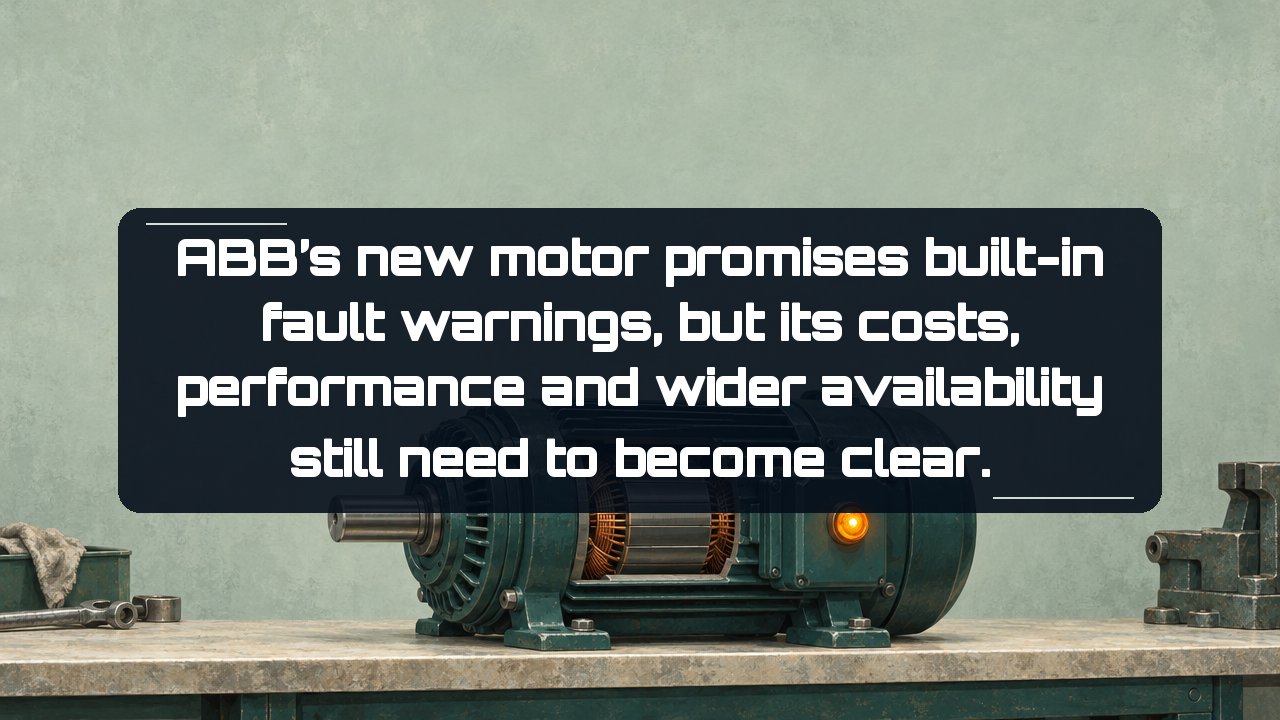

ABB says it has launched Intelleqt, an industrial motor with monitoring built into the equipment, at the SPS trade fair in Germany. Its announcement dated 24 November 2026 says the motor is entering joint development with equipment makers and users. ABB plans a broader rollout in 2027, initially covering Europe, Japan, China and India. The report does not say when general availability or firm deliveries will begin.
For maintenance teams, the proposed benefit is equipment that can report signs of wear without a separate sensor installation or a compulsory cloud connection. One reading is that this could make monitoring easier to introduce. Whether it reduces work and costs depends on the quality of the warnings and what customers must do to act on them.
What the motor would tell workers
ABB’s Intelleqt product page describes continuous sensing, processing on the motor itself, wireless connections and energy harvesting, meaning collecting energy for use. The company says the equipment measures magnetic fields inside the motor and temperature, alongside vibration analysis.
ABB says indicator lights, local fault checks and a Bluetooth mobile app, using a short-range wireless connection, can provide basic readings without an internet or cloud connection. That offers a proposed way to inspect the motor without sending its information to remote computers. The report does not say that every feature works offline.
The company also says its diagnostics can detect deterioration weeks before failure. The report does not say whether independent tests have verified measurement accuracy or reliability, or how often warnings miss faults or raise false alarms. Those details would help maintenance teams judge when a warning warrants action.
ABB calls Intelleqt the world’s first low-voltage industrial motor meeting IEC international electrical standards with built-in intelligence. The report does not say whether an independent comparison supports that claim.
Where the AI functions sit
ABB presents Intelleqt as a way to expand industrial artificial intelligence, or AI. Its product page places AI-driven analysis and information about groups of motors under the optional ABB Ability Powertrain service.
The report does not say which diagnostic methods on the motor itself use AI. Built-in intelligence therefore remains ABB’s description of the product, rather than evidence of an autonomous AI system.
One reading is that the distinction matters less to a maintenance worker than the usefulness of a warning, but it matters when judging the announcement. Local sensing, local fault checks and optional remote analysis are separate promises. A demonstration of one would not, by itself, demonstrate the performance of the others.
Cloud choice leaves other costs open
ABB says local diagnostics require no subscription. Optional cloud connections and its extended Powertrain service may involve separate commercial terms. The report does not say what the motor costs or provide a priced comparison of those service choices. Subscription-free local functions therefore cannot yet be translated into a total ownership cost.
The company describes Intelleqt as factory-fitted equipment, rather than a package added to an existing motor. It says this avoids external sensors and a separate installation project. The report does not say what replacing an existing motor would cost or how practical that would be. A design intended to simplify installation still leaves that purchasing decision open.
ABB also says customers own their data and choose whether it leaves the facility. The report does not say what contractual terms support that promise or whether data handling has undergone an independent security assessment.
The company says customers can export the data and connect it to platforms supporting MQTT, a standard way for devices to exchange messages. The report does not say whether those connections have been demonstrated or how much work customers would need to link the motor to their existing software.
One reading is that ABB is offering choices about where data is processed and how it is used. Those choices could matter to operators who want local monitoring, but they leave commercial and technical questions for customer development to resolve.
What the savings figures describe
ABB’s announcement promotes opportunities to save 30% or more in energy and potential reductions in unplanned downtime of up to 50%. These describe possible benefits, not measured results from Intelleqt trials.
Energy publication Energin’s report explicitly makes that distinction. ABB draws the percentages from general material attributed to the International Energy Agency, an energy policy body, and McKinsey, a consultancy. ABB’s report does not say how those sources’ methods and scope apply to this motor. The IoT M2M Council’s coverage of the launch also follows ABB’s announcement.
ABB’s failure-cost example assumes a critical motor rated at 110 kilowatts causes 12 hours of downtime, including removal, installation and commissioning. The scenario concerns a particular assumed failure, rather than a reported customer outcome.
ABB applies an hourly cost of $124,669 to reach roughly $1.5 million for that incident. The arithmetic supports the rounded total, but the report does not say which currency it uses or identify a source for the stated global hourly median. The example illustrates an assumed cost of failure, not a measured saving from buying Intelleqt.
Why better data is only part of deployment
Consultancy Deloitte’s manufacturing AI survey provides separate industry context. Deloitte reports that 84% of surveyed manufacturers gain measurable value from AI, while only 20% of use cases have been expanded beyond limited use. Those percentages count different things: manufacturers in one case and applications in the other.
Deloitte says its survey covered more than 140 manufacturing organisations. It concerns manufacturing generally, rather than Intelleqt, and the report does not say enough about the full sampling and survey methods to assess how representative the findings are.
Deloitte reports that 43% identified high implementation costs as a challenge, compared with 30% citing data availability or quality. Cost was the more commonly reported obstacle. The survey also identifies shortages of technical expertise, resistance to change and regulatory concerns.
One reading is that better equipment data can address only part of the problem. A motor that supplies its own readings still needs to fit the organisation’s maintenance practices, software and budget.
What customer development needs to show
ABB’s planned customer development offers a way to test its design promises. Useful results would include named customer trials, published warning performance, clear commercial terms and demonstrated connections to existing systems.
The unresolved issue is whether built-in monitoring makes maintenance simpler in daily use. Evidence that workers can turn its readings into sound repair decisions would be more useful than another broad savings estimate.