
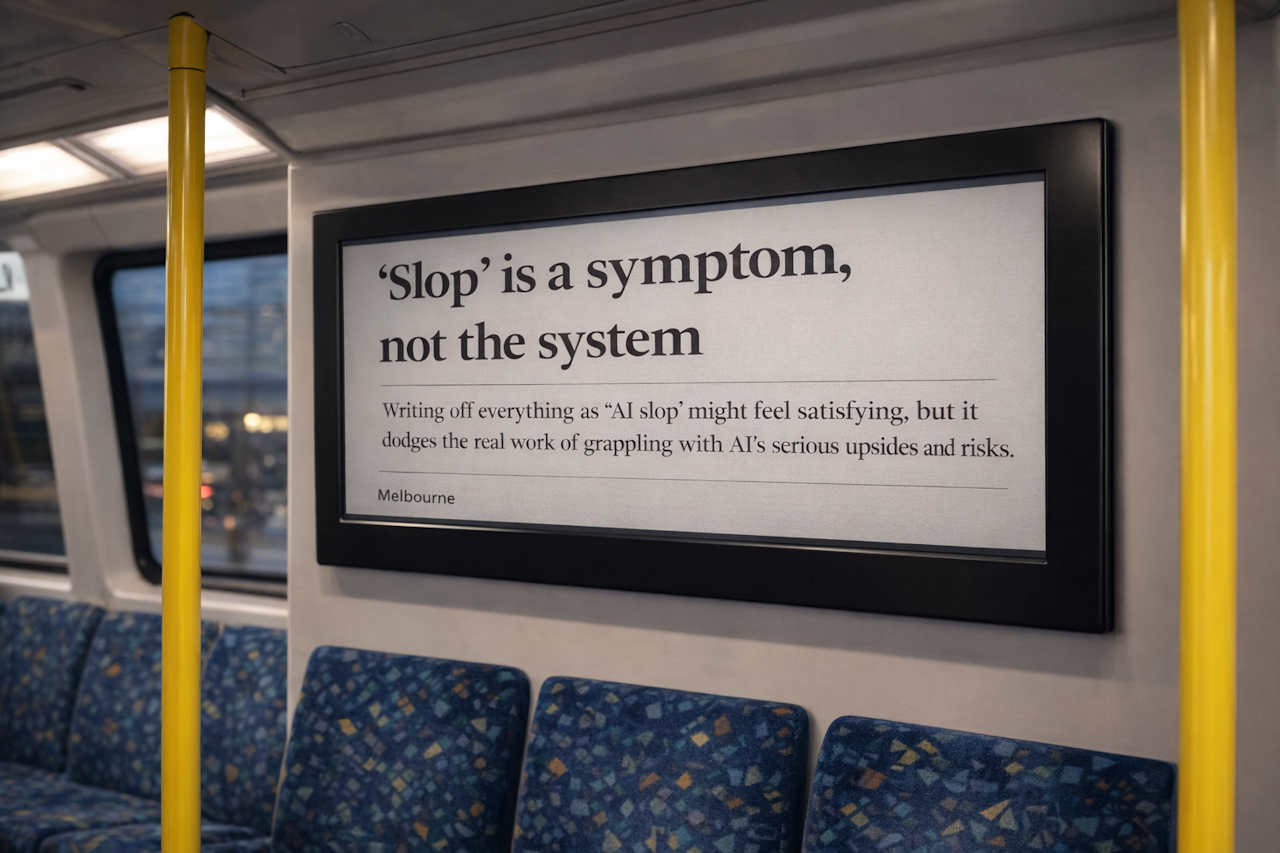

The phrase “AI slop” has become shorthand for the flood of low-effort, machine-generated posts, images and videos engineered to farm clicks, ad revenue and affiliate sales. A familiar pattern is emerging: cheap generation plus frictionless distribution plus opaque recommendation systems can produce an internet that feels noisier, less trustworthy and harder to search.
But “slop” is not the technology; it’s the business model and distribution environment around the technology.
Labelling everything as slop collapses crucial distinctions between (a) deliberate spam, (b) legitimate but mediocre automation (such as templated marketing copy), and (c) genuinely high-value applications such as medical documentation assistance, scientific coding support, accessibility tools and translation. Treating all of it as one bucket makes it harder to target the real levers: platform incentives, identity and provenance, ad-tech fraud controls, and procurement standards.
It can also advantage bad actors. If all AI output is presumed worthless, audiences can become less willing to verify anything at all—an outcome disinformation campaigns often seek to encourage.
The promise is seismic — even if productivity gains are uneven
There is evidence that AI can lift productivity and change how work is organised, even if the gains do not land evenly. The OECD’s work on AI and labour markets has emphasised that exposure to AI varies widely by occupation, with some high-skill roles more exposed to task automation than public debate sometimes assumes. Meanwhile, the IMF has estimated around 40% of jobs globally are exposed to AI, arguing the distributional effects could widen inequality unless policy and institutions keep pace.
Those top-line figures are debated: “exposure” is not the same as “replacement”, and different studies use different task taxonomies. Still, it is plausible that AI will reshape education pathways, wage bargaining, workplace surveillance, and the boundary between professional and “consumer” tools (for example, when employers expect staff to draft, summarise and analyse at the speed of a chatbot).
Calling it all “slop” encourages a lazy equilibrium: employers may dismiss worker concerns (“it’s just a toy”), while workers may dismiss genuine upskilling as “all hype”. Both responses can be costly. If AI meaningfully changes how legal discovery, customer service triage, software testing or radiology pre-reading is done, then unions, regulators and boards need sober, domain-by-domain assessments—not vibes.
The risks aren’t only bad content — they’re governance failures
The most consequential harms are often not the awkward image macros, but failures of governance: biased decision-making, insecure deployments, opaque vendor contracts, and systems that cannot be audited when something goes wrong. That’s why frameworks such as the NIST AI Risk Management Framework (AI RMF 1.0) focus on lifecycle risk controls—govern, map, measure, manage—rather than aesthetic judgements about output quality.
When “AI slop” becomes the dominant frame, it can drag attention towards surface artefacts (the weird fingers, the generic prose) and away from deeper questions: Who is accountable for model errors? What data rights were respected? What cyber security testing was done? What happens when a model is integrated into critical infrastructure, health intake, credit assessment or policing analytics?
International policy is moving—unevenly—towards risk-based regulation. The Council of the European Union’s announcement of final approval of the EU AI Act outlines obligations scaled to risk, plus new transparency expectations around certain AI systems. Whether the AI Act proves effective in practice is contested (including questions about enforcement capacity and how “general-purpose AI” obligations will operate), but the direction matters: governments are treating AI as a governance problem, not merely a content-quality problem.
Australia’s debate needs more than culture-war shorthand
In Australia, “AI slop” talk can bleed into broader cynicism: AI as Silicon Valley grift, as a cheat code for students, or as a threat to creatives. Some scepticism is healthy. But the national interest demands specificity.
The Australian Government’s AI Ethics Principles lay out expectations around human-centred values, fairness, privacy and security, transparency, contestability and accountability. They are voluntary, and critics argue voluntary principles may not keep pace with commercial deployment. Even so, the principles provide a practical vocabulary for procurement, risk assessment and incident response that the “slop” frame simply cannot.
Similarly, the government’s “Safe and responsible AI in Australia” discussion paper canvassed regulatory options because the challenge is not limited to online junk content: it also concerns consumer protection, discrimination law, product liability, and what standards should apply when AI tools are used in high-stakes contexts.
If Australians want to argue about AI’s place in schools, newsrooms, Centrelink call centres, local councils, hospitals or banks, the conversation needs to move from mockery to design choices: what should be disclosed, when must a human review occur, how will errors be appealed, and what logs must be kept for later audits?
“Slop” obscures the energy and infrastructure trade-offs
Generative AI doesn’t just produce more content; it consumes infrastructure—compute, cooling, networking, chips and electricity. The International Energy Agency’s Electricity 2024 outlook highlights rapid growth in electricity demand from data centres and related digital infrastructure in some regions. Exactly how much of that growth is attributable to generative AI (versus cloud services more broadly) remains uncertain, and researchers have criticised the lack of consistent disclosure from companies. A Nature news feature on the opacity of AI’s energy footprint notes that the numbers are hard to pin down without better reporting.
This matters for Australia because energy debates are already politically loaded: reliability, transition pathways, prices and industrial policy. If AI is treated as a punchline (“just slop”), then energy planning may underweight potential demand growth from accelerated data centre build-outs; if AI is treated as a miracle, it may be used to hand-wave away real costs.
The point is not that AI is uniquely wasteful; it is that AI can act as an amplifier. It can amplify productivity, but it can also amplify energy demand, water use for cooling, and supply-chain pressures for semiconductors. Those are policy questions, not meme questions.
The real information crisis is provenance, not taste
“AI slop” is sometimes used to mean “content I don’t like”, but the harder problem is whether we can tell what to trust—especially during elections, disasters and conflicts. The United Nations has leaned into the need for governance and coordination through work such as its High-level Advisory Body on AI, which has argued for globally interoperable approaches to safety, access and accountability (with debate about feasibility, sovereignty and enforcement).
In practice, provenance solutions will be partial: watermarking can be stripped; metadata can be lost; detectors can fail; and human-led disinformation can be just as potent. Yet without better provenance, content moderation becomes an arms race, and the public is left doing difficult authenticity checks at scroll speed.
That is why the “slop” framing can be counterproductive. It trains people to judge by vibe (“looks fake”), when the more resilient habit is procedural: check sources, check context, look for corroboration, understand incentives, and demand disclosure from institutions. In other words, the opposite of doomscrolling through a sludge of content and giving up.
A better vocabulary: junk, tools, and systems
If “AI slop” is the only label available, it will be overused—because it is emotionally satisfying, and because it can signal taste and group identity. But AI is not one thing. It is a bundle of capabilities embedded in systems: search, recommender feeds, surveillance, workplace analytics, translation, customer service, medical triage, education tech, creative software, and cyber security.
So use sharper words. Call spam “spam”. Call fraud “fraud”. Call deepfake harassment “image-based abuse”. Call negligent deployments “unsafe systems”. And when AI is genuinely helpful, call it that too—while still demanding evidence, testing, and accountability.
At this point in our society, the temptation is to treat AI as background noise: another tech wave, another platform mess. But dismissing it as “slop” doesn’t reduce its impact; it can reduce our capacity to respond. The internet may well be filling with junk. The more urgent question is whether institutions—schools, regulators, courts, companies and media—can handle the profound social, economic and environmental consequences of machines that generate, predict and decide at scale.
The work ahead is slower than a meme and harder than a dunk: build standards, enforce transparency, align incentives, protect people, and keep the benefits broadly shared.