
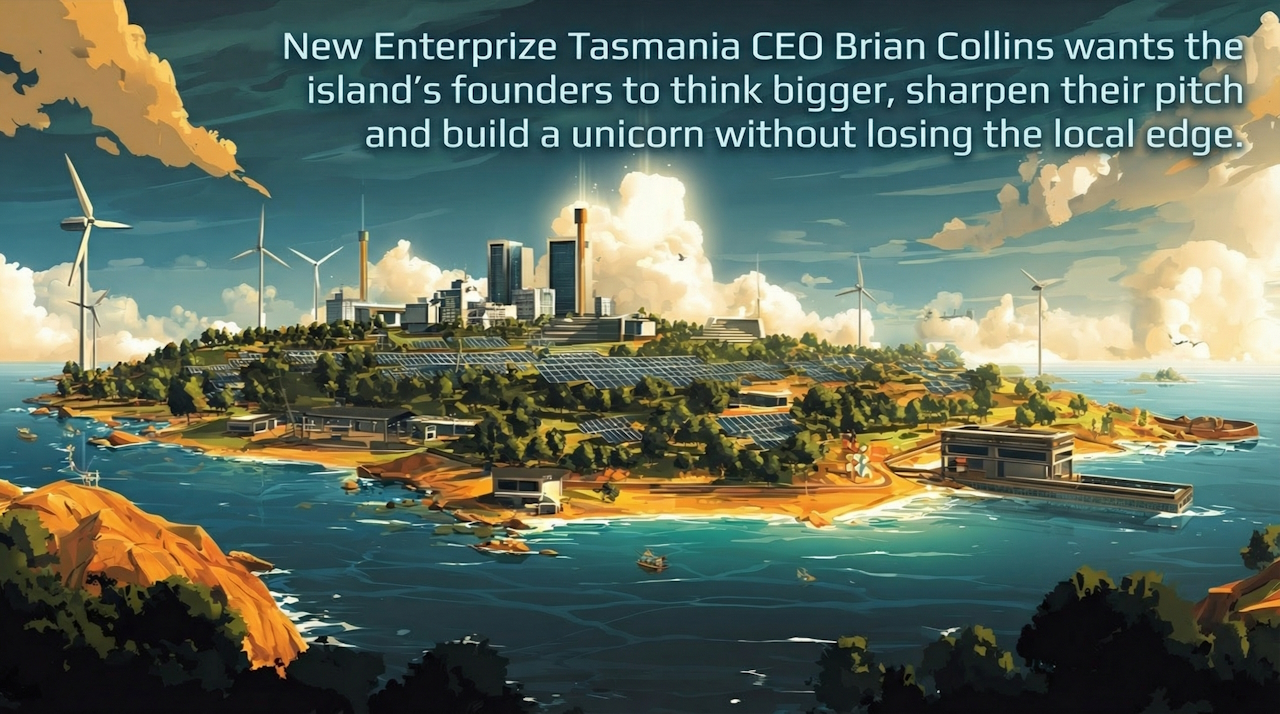

Tasmania has form when it comes to punching above its weight. The Museum of Old and New Art (MONA) helped reframe Hobart as a cultural destination and shifted how outsiders talk about the island. Collins’ argument — as outlined in Capital Brief’s profile of his appointment — is that the startup ecosystem needs its own catalytic story: a breakout company that becomes shorthand for “serious innovation happens here”.
The comparison is deliberately provocative. MONA was a single, high-impact bet that drew visitors, talent and media attention. A startup “MONA moment” would more likely be a chain reaction: a locally founded company scaling globally, creating experienced operators, alumni angels and a repeatable playbook. Collins wants founders to hold that ambition without losing what makes Tasmania distinct: proximity, lifestyle, and tight networks that can accelerate trust-based collaboration.
Who is Brian Collins — and why the role matters
Collins comes to Enterprize Tasmania from Triple Bubble, and his elevation to CEO signals an emphasis on commercial execution and scale thinking. Enterprize Tasmania positions itself as a connector across founders, corporates, investors and government, and the CEO’s tone can set expectations for the whole pipeline — from idea-stage meetups to investment readiness and interstate relationships.
Collins is inheriting a structural challenge: Tasmania has strong community energy, but a comparatively small local market and a limited pool of later-stage capital. In that context, a startup organisation’s job is less about hype and more about scaffolding — helping founders access mentors with scaling experience, find customers beyond the state early, and build investor-grade narratives that stand up in Sydney, Melbourne and overseas.
At the time of writing, the conversation he appears to be trying to start is clear: Tasmania shouldn’t benchmark itself only against other small regions; it should benchmark against the global companies it wants to build.
The island advantage: density, trust and “fast feedback”
Tasmania’s ecosystem benefits from density. In smaller communities, introductions can happen quickly, and founders can get “fast feedback” from advisers, potential customers and technical peers. That can compress learning cycles — a meaningful advantage when teams are small and runway is limited.
The flip side of density is that it can also reinforce local ceilings if networks become too inward-looking. Collins’ “think bigger” message is, in part, an antidote to that risk: keep the speed of local relationships, but export early. For Tasmanian startups, “going global” often means “going to the mainland first”, then pushing into international markets once product–market fit is clearer.
A practical implication is that local programs may need to reward outward motion: customer discovery trips, interstate pilots, and founder travel that builds capital and enterprise links. If a MONA-like story is to emerge, it will likely come from a company that treats Tasmania as a base, not a boundary.
Capital and scale: the perennial bottleneck
Most Australian startup ecosystems talk about capital gaps, and Tasmania’s can be amplified by geography and a smaller local fund presence. Early-stage grants and angel cheques can get teams started; the harder step is bridging into sustained growth capital, especially for companies that need to hire quickly or expand into enterprise sales cycles.
Collins’ pitch — that Tasmania can produce Australia’s next unicorn — is partly about ambition, but also about preparing founders for the scrutiny that comes with larger cheques. “Sharpen their pitch” isn’t cosmetic: it’s about clarity on customer pain, traction signals, unit economics, and a credible go-to-market plan.
For investors, Tasmania can be compelling when a startup has:
- a strong technical moat or niche domain expertise;
- early evidence of demand beyond the local market; and
- a team that can sell and recruit nationally.
The ecosystem’s challenge is to increase the number of companies that reach that investable threshold — and to build pathways so capital doesn’t default to mainland firms simply because they are closer to major funds.
Talent: small teams, big roles, and a retention play
Tasmania’s lifestyle appeal is well recognised, but lifestyle alone doesn’t scale companies. The state’s startups often need “full-stack” employees early — engineers who can ship product and speak to customers; marketers who can handle performance, brand and partnerships; and operators who can build systems while wearing multiple hats.
That creates a talent paradox. The island can attract people looking for a different pace of life, but many experienced scaling operators remain concentrated in larger cities. One option is hybrid models: senior hires based interstate with regular Hobart/Launceston time, paired with locally based teams that hold product context and community ties.
If Tasmania does achieve a breakout unicorn, its most durable legacy may be talent retention: founders and early employees who stay on the island and start or fund the next generation. That’s one way ecosystems can compound — not just through one big exit, but through repeated cycles of experience and capital.
What a Tasmanian unicorn would likely look like
The “next unicorn” framing is aspirational, but it also forces a useful question: what kinds of companies can plausibly scale from Tasmania? Geography typically matters less for software and deep tech than for heavy manufacturing, though physical supply chains and prototyping requirements still influence certain sectors.
A Tasmanian unicorn is more likely to emerge from categories that suit distributed execution and global markets: B2B SaaS, cybersecurity, data platforms, health tech, or specialised climate/energy software. It could also come from domain-driven innovation tied to the state’s strengths — agriculture, aquaculture, Antarctic and marine research, or renewable energy — if founders can productise expertise and sell to much larger markets.
The key point is that “Tasmanian” doesn’t have to mean “small”. It can describe an origin story and a community base, while the company itself is built with global customers in mind from day one.
The MONA lesson: audacity backed by execution
MONA worked not only because it was a bold idea, but because it was backed by sustained investment in experience, brand and narrative that kept bringing people back. Collins’ challenge at Enterprize Tasmania is similar: ambition needs to be paired with a repeatable engine that helps founders build, sell and raise.
That will likely involve clearer pathways between community events, accelerator-style support, investor readiness, and interstate networks — plus a culture that normalises big goals without punishing failure. Tasmania’s ecosystem doesn’t need to mimic Silicon Valley; it needs to develop its own model for global ambition from a small, connected place.
Collins is betting that with sharper storytelling and stronger execution discipline, the island can generate a company that changes how Australia — and investors offshore — talk about Tasmania. Whether that “MONA moment” arrives as one breakout unicorn or a wave of scaled firms, the direction is the same: think bigger, sell beyond the island, and keep the local edge that makes the ecosystem coherent.