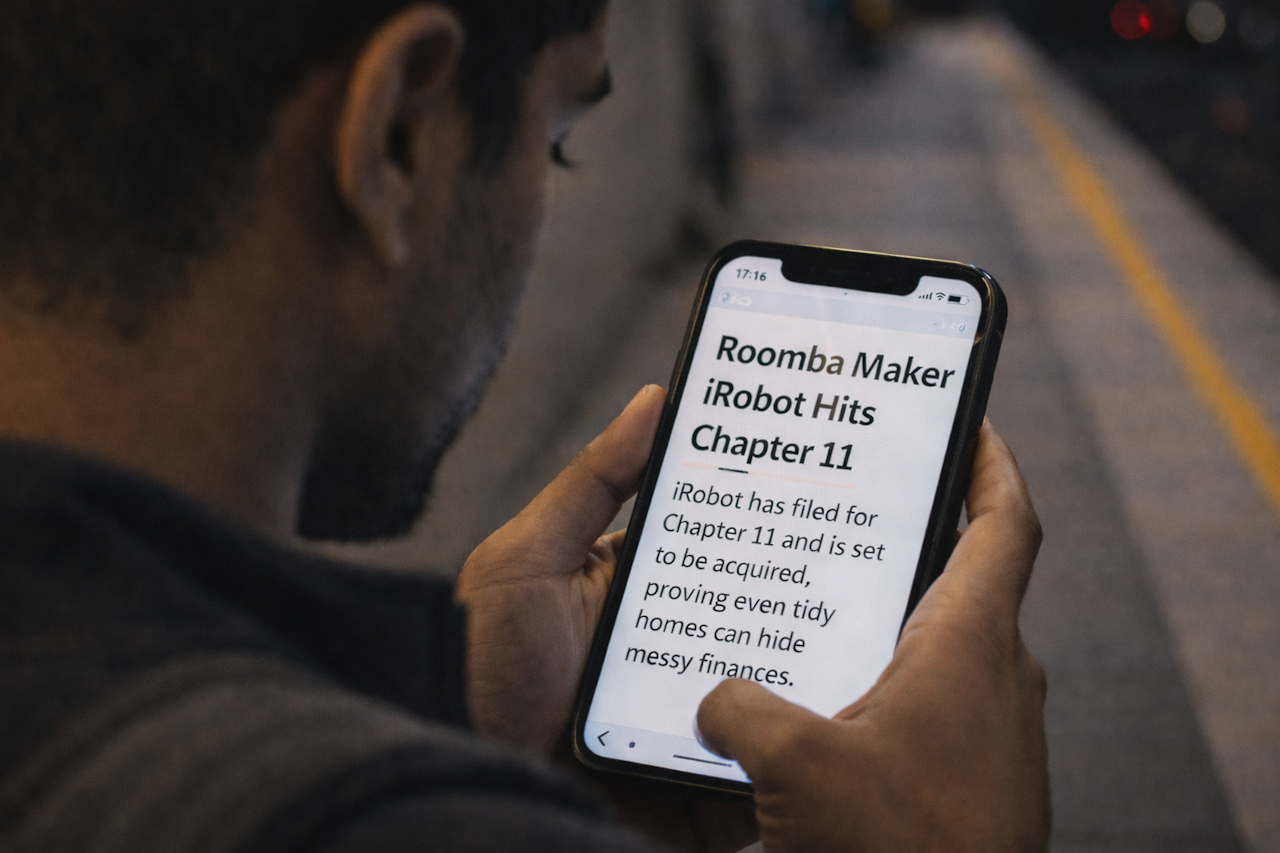

iRobot says it has commenced voluntary Chapter 11 proceedings in the US Bankruptcy Court for the District of Delaware, pairing the filing with a deal to sell the business through a court-run process to its “secured lender and primary contract manufacturer”, Shenzhen-based Picea Robotics. In its announcement, iRobot framed the move as a way to keep operating while it restructures its balance sheet and ownership, rather than a signal that Roombas are about to vanish from shelves tomorrow. (In general, Chapter 11 bankruptcy protection is designed to allow companies to keep trading while they reorganise, subject to court oversight.) Details are set out in iRobot’s Chapter 11 press release and have been reported by Reuters’ coverage of the filing and proposed acquisition.
A key point for readers: Chapter 11 is a legal framework to restructure debts and contracts under court supervision. That can include selling the company (or its assets) via a process intended to maximise value for creditors, sometimes through an auction where other bidders can emerge. The fact that iRobot has lined up Picea as the intended buyer doesn’t necessarily mean it’s the only possible buyer—though it often signals that the “stalking horse” offer has been negotiated in advance to set a floor price and keep the process moving. Chapter 11 sales can involve auctions and stalking-horse bids, but iRobot describes this as a pre-packaged process with terms negotiated in advance.
Why the maker of Roomba ran out of room
iRobot’s trouble has been building for years, and it follows patterns seen in many consumer hardware businesses: intense price competition, margin pressure, and limited ability to sustain premium pricing as products become commoditised. In recent years the robot vacuum category has filled with capable rivals—many with aggressive pricing, rapid model cycles and heavy online promotion—making it harder for iRobot to command premium prices for the Roomba name alone.
iRobot’s own disclosures in its US filings describe persistent losses and liquidity strain; iRobot raised going-concern doubts in March 2025 (and others have echoed that it flagged this risk).
The other big shock was strategic: iRobot had been counting on a deep-pocketed acquirer to stabilise the business. When that didn’t eventuate, the company had to attempt a turnaround while still competing in a fast-moving segment.
Reuters has reported that after the collapse of the Amazon deal (more on that below), iRobot pursued cost cuts and restructuring, but continued to face weak demand and heavy competitive pressure. In that context, Chapter 11 can be read as a mechanism to reduce and reorganise obligations under court supervision while seeking a buyer aligned with how the products are manufactured and distributed.
Picea Robotics: from factory floor to owner
The most striking element of iRobot’s filing is who is poised to buy it. iRobot says it will be acquired by Picea Robotics, a Shenzhen-based company described as iRobot’s primary manufacturer—effectively the partner that turns designs into devices at scale. That relationship matters: in consumer electronics, manufacturers often have strong visibility into demand shifts (for example, through order volumes, component commitments and logistics schedules) and can hold leverage via supply terms, tooling, and working-capital arrangements.
According to iRobot’s announcement, the transaction is structured to run through a court-supervised sale process. That matters because it can allow certain liabilities and contracts to be dealt with through the process, and it provides a legal pathway for the winning bidder to take control with clearer title (subject to court orders and the final sale terms). Further detail is referenced in iRobot’s disclosures, including an agreement filed with regulators; key documents are typically made available through iRobot’s bankruptcy noticing agent and via iRobot’s SEC reporting.
What changes under a manufacturer-owner model? Potentially a lot—and not all of it is about cutting costs. A manufacturer-led owner may push for fewer SKUs, more shared platforms across models, simplified parts inventories, and supply chain discipline that prioritises steadier output over rapid product churn. The flip side is that brand-building, software differentiation and long-term R&D can suffer if the owner’s strengths lie more in manufacturing efficiency than in consumer marketing and product ecosystems. Whether Picea plans to invest in iRobot’s software, mapping, and services layer—or treat Roomba primarily as a hardware label—will be one of the crucial questions in 2026.
The Amazon deal that didn’t happen, and the aftermath
iRobot’s would-be saviour was once Amazon. In 2022, Amazon announced plans to buy iRobot for US$1.4 billion, pitching the deal as a way to combine smart home ambitions with one of the best-known consumer robotics brands. Regulators, particularly in Europe, signalled concerns about market power and competition. Reuters reported in January 2024 that Amazon and iRobot abandoned the deal after EU opposition, with the European Commission’s concerns reportedly including the risk that Amazon could disadvantage rival robot vacuum makers on its marketplace or through its ecosystem (Reuters on the abandoned Amazon–iRobot deal). Separate reporting also indicated EU regulators were preparing to block the deal, according to sources cited by Reuters at the time (Reuters on EU concerns about the transaction).
When the Amazon acquisition fell apart, iRobot publicly acknowledged the need for sweeping changes, including restructuring and layoffs. iRobot’s own statement at the time pointed to the company’s need to “restructure” to preserve liquidity and keep operating amid the sudden end to a deal it had expected to close (iRobot’s newsroom statement on the termination). The timing added pressure: a consumer hardware business already squeezed by competition had spent months in acquisition limbo, then had to pivot quickly back to a standalone survival plan.
That episode is relevant context for interpreting the Chapter 11 filing. A manufacturer-led acquisition may be seen as a more operationally driven alternative to a Big Tech acquisition, particularly where regulators raise competition concerns.
What Chapter 11 could mean for Roomba owners
For consumers, the immediate concern is whether Roombas will keep working—particularly models that rely on cloud services, app logins, map storage and firmware updates. iRobot has said it intends to continue operating in the ordinary course during the Chapter 11 process, subject to court approvals for certain payments and programs (including customer-related obligations), and it has indicated it will keep serving customers while it restructures.
Still, Chapter 11 creates uncertainty. Even when a company keeps trading, priorities can shift quickly: cash is conserved, suppliers renegotiate, product roadmaps are reviewed, and support arrangements can change after a sale closes. Consumer guidance outlets have urged buyers to keep proof of purchase and monitor official updates, noting that warranties are often honoured during Chapter 11 but can depend on court approvals and the eventual buyer’s plans. A practical explainer is available via CNET’s guide to warranties and support during iRobot’s bankruptcy process, and broader advice on what owners should watch for regarding their data has been published by The Washington Post.
There is also a more subtle risk: not whether a vacuum stops vacuuming tomorrow, but whether the long-term “smart” layer degrades. If servers are consolidated, if an app is merged, or if analytics and mapping features are deprioritised, users may gradually lose the experience they paid for. None of that is guaranteed to happen, and buyers sometimes invest heavily to reassure customers—but it is the kind of longer-term possibility consumers may want to factor in with any connected-device bankruptcy.
The bigger lesson: hardware brands need moats, not memories
iRobot helped popularise the idea that a robot vacuum could be a mainstream appliance. The modern robot vacuum market, however, is less about novelty and more about execution: navigation accuracy, mopping performance, hair handling, battery management, parts availability, noise levels, and the reliability of apps and updates. Once competitors achieve “good enough” on core performance, competition can shift towards price, promotion, and distribution—areas where a mid-sized specialist may struggle against larger consumer electronics brands and marketplace-native players.
This is where iRobot’s situation can serve as a case study in the limits of brand equity. Roomba remains a household name, but brand alone does not guarantee margins if the feature gap narrows. A more durable competitive moat in this category might include proprietary mapping that measurably outperforms rivals; a services ecosystem users actively pay for; stronger privacy and security assurances; or a repair-and-parts network that makes ownership cheaper over five years than lower-cost alternatives. These approaches are possible, but typically require sustained investment and a long time horizon—difficult when cash is tight and debt is due.
It is also a reminder that supply chains can be strategic, not just operational. If your “primary manufacturer” becomes your buyer, the value of manufacturing relationships shifts from being a cost centre to being a pathway to ownership—something that may become more common when consumer hardware companies look for leaner structures and fewer intermediaries.
Wrap-up
iRobot’s Chapter 11 filing marks a sharp turn for one of consumer robotics’ best-known names, with a proposed sale to Shenzhen-based Picea Robotics turning a long-standing manufacturing relationship into a likely ownership change. In the near term, iRobot says it will keep operating through the court process. Over the longer term, the key question is whether a manufacturer-led iRobot can protect the Roomba brand while investing enough in software, support and product differentiation to compete in a crowded market.