
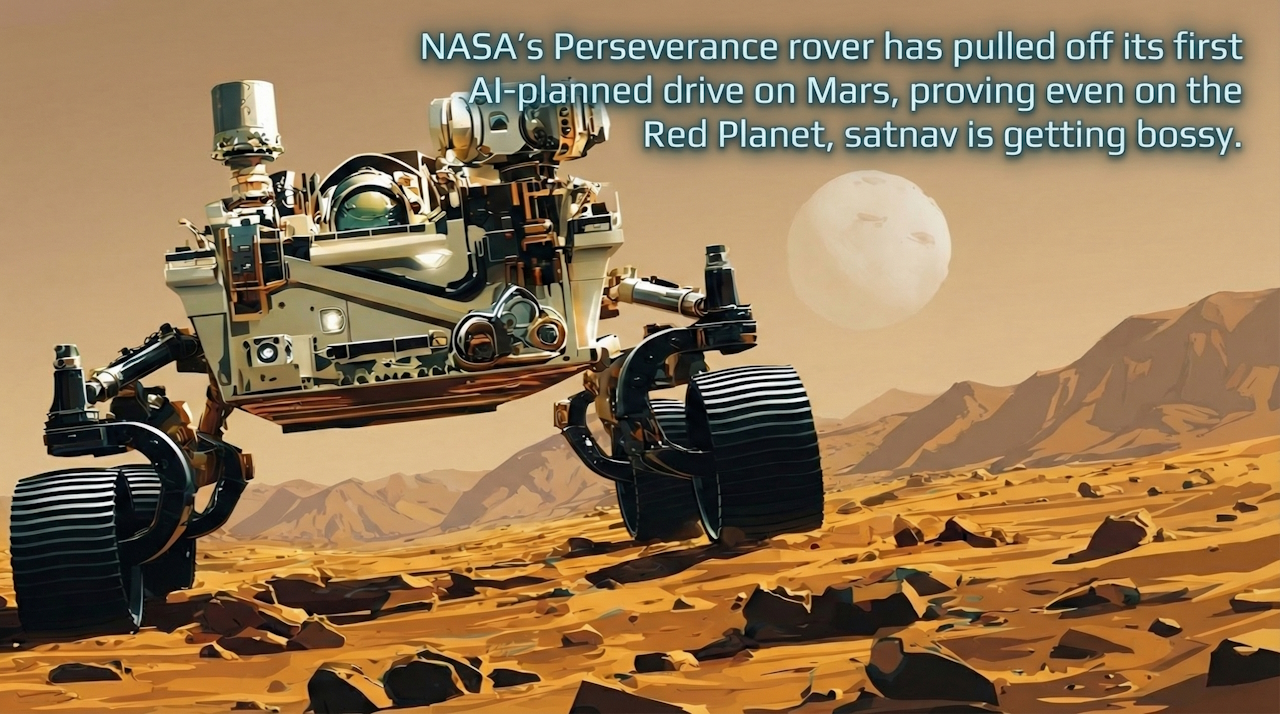

The idea of a rover “thinking ahead” while it trundles across Mars shifted from a lab demo to a logged achievement. According to a NASA Jet Propulsion Laboratory (JPL)-Caltech update republished by ScienceDaily’s report on the AI‑planned drive, Perseverance has completed what the team describes as the first drive on Mars whose plan was produced onboard by artificial intelligence.
That wording matters. Mars rovers have long driven autonomously in the narrower sense—detecting hazards, picking a safe path around rocks and stopping if they’re unsure. What’s new here, per the release, is that Perseverance didn’t just execute a human-sequenced route: it generated a drive plan itself, then carried it out without waiting for the next day’s command upload from Earth.
It’s a modest step in distance compared with the rover’s headline-grabbing science, but it appears to mark a shift in operations: less “remote-controlled robot” and more “field assistant” that can make bounded decisions when the ground team is offline, busy, or simply too far away.
Why autonomy is hard when Earth is 200 million kilometres away
Mars is unforgiving for anyone who likes to tweak things in real time. Signals between Earth and Mars take minutes to travel one way, depending on where the planets are in their orbits—making joystick-style driving impractical. Perseverance operations account for that by batching commands and sending daily activity sequences.
Even so, the rover’s environment can change faster than the schedule. Dust can obscure features, shadows can complicate stereo vision, and what looks like safe ground from orbit can turn out to be difficult terrain up close. NASA’s own mission overview notes Perseverance is tasked with detailed geological work and sample collection in Jezero Crater, a landscape chosen because it once hosted water and is complex and uneven (NASA’s Mars 2020 mission site).
Traditional rover driving often involves a trade-off: move cautiously to reduce risk, or push for distance and accept more uncertainty. Autonomy aims to reduce that tension by letting the rover evaluate the terrain as it goes—and, in this reported “AI‑planned” case, by letting it decide the plan for the drive itself.
From AutoNav to onboard planning: what’s actually new
Perseverance already carries an autonomous navigation system called AutoNav, which uses navigation cameras and onboard computing to build a 3D view of the terrain, identify hazards and select a safe path around them. NASA explains AutoNav as a way for the rover to drive with less frequent human intervention, especially in rough terrain where pre-planned routes can be too optimistic (how AutoNav works on NASA Mars 2020).
JPL has been steadily expanding those capabilities. A 2023 JPL story described a software update that allowed Perseverance to drive faster by “thinking while driving”—processing images more quickly so it can make navigation decisions without stopping as often (JPL’s “Fast‑Tracked” software update explainer).
The 2026 report positions the latest achievement as a further evolution: not merely hazard avoidance, but planning—assembling a drive plan onboard using AI techniques and then executing it. In rover terms, planning means juggling constraints such as energy, time, terrain risk, and science priorities. When planning is done on Earth, engineers can weigh those factors with richer context and more computing power, but they’re constrained by the once-per-sol rhythm of sending commands.
Onboard planning flips that. It asks the rover to decide how far it can safely go right now, given what it can see, what it knows about itself, and what it must still accomplish today.
Technical work on this kind of autonomy has been developing for years. A conference paper on “onboard planning” for Perseverance describes efforts to improve rover autonomy by allowing more decision-making to happen on the vehicle itself, reducing reliance on ground-in-the-loop sequencing (SPIE conference proceedings on onboard planning for Perseverance). Such papers are not mission announcements, but they provide useful engineering context for the milestone now being publicly reported.
The practical payoff: more metres, more science, fewer “wasted” sols
For the public, “AI” can sound like a marketing label, but rover operations are typically judged on practical outcomes: getting more done per sol while staying safe. Every time Perseverance stops to wait for instructions, it can lose hours that might otherwise be used to reach a new outcrop, position a drill, or capture a panorama. If onboard planning lets the rover continue making productive progress between communications windows, the mission can gain time—one resource no software update can create.
There’s also a compounding effect. The more reliably the rover can handle routine driving and short-horizon decisions, the more the ground team can focus on higher-level science choices: which rock to sample, which layer to image, and which ridge to prioritise. NASA’s mission brief underscores Perseverance’s core job as collecting and caching samples that may later be returned to Earth, along with studying Mars’ past habitability. Those objectives don’t just require instruments—they require the rover to physically reach the right places.
The autonomy story is also about safety. By planning based on what it can currently perceive, the rover may reduce the risk of getting boxed in by unexpected hazards. That does not remove the need for cautious engineering, but it can make cautious engineering more efficient.
Is it really “the first” AI‑planned drive? Parsing the claim
The phrase “first AI‑planned drive on Mars” is a strong claim, and it’s worth reading carefully. Rovers such as Curiosity and Perseverance have used autonomous navigation for years, and the Mars Exploration Rovers (Spirit and Opportunity) also had early forms of onboard hazard avoidance. So the “first” here appears to refer specifically to planning the drive onboard—not just choosing a safe path moment to moment.
Outside NASA’s wording, there is not (yet) a universally agreed public definition of what counts as an “AI‑planned” drive. Some autonomy systems are rule-based; others use optimisation; others incorporate machine learning. The ScienceDaily item attributes the claim to NASA/JPL-Caltech, and without a detailed technical breakdown in the public-facing release, it is safest to treat “AI‑planned” as NASA’s shorthand for onboard automated planning rather than an open-ended system generating its own mission goals.
That doesn’t diminish the achievement; it clarifies it. In space robotics, “AI” often refers to constrained, testable algorithms that can be verified and trusted—not an open-ended system that invents objectives. NASA’s broader autonomy research similarly frames AI as a way to help spacecraft interpret their surroundings and make bounded decisions, rather than replace human-set mission intent (NASA TechPort’s overview of autonomous exploration for rover navigation).
In other words, the rover is not “going rogue”. It is operating within limits designed by the mission team, with automation intended to handle routine tasks safely.
What it means for future missions — and for humans on Mars
Perseverance is effectively a testbed for an operations style that may be useful on more distant or more demanding missions. As missions push farther out—or attempt to do more on Mars with limited ground staffing—the cost of constant human involvement rises. Autonomy becomes less of a bonus and more of a capability that can enable new kinds of operations.
For sample return, autonomy could help rovers traverse challenging terrain to retrieve cached tubes or scout landing zones. For future robotic missions to the Moon and Mars, onboard planning may allow spacecraft to respond to rapidly changing conditions such as lighting shifts, dust, communications dropouts, or time-critical events.
For eventual human exploration, smarter robots could act as force multipliers. Astronauts would still need robust, predictable systems, but may benefit from robotic partners that can do useful work independently—from scouting routes to hauling gear—while the crew focuses on tasks that require human judgement. Perseverance’s incremental steps in autonomy are the sort of engineering foundation that can support more ambitious exploration.
The road ahead: cautious autonomy, not autopilot bravado
If there’s a lesson in this milestone, it’s that autonomy in space is earned in small, validated steps. Perseverance’s AI-planned drive, as described by NASA/JPL-Caltech via ScienceDaily, is evidence that onboard planning can work under real Martian constraints: limited power, limited compute, imperfect sensing, and no easy recovery options.
The next chapters are likely to be incremental too: longer autonomous plans, more complex choices about where to stop and image, and tighter integration of science goals with navigation. Each change must be tested against the rover’s overriding requirement: avoid getting stuck or damaged in terrain that cannot be serviced.
For now, the significance is straightforward. Perseverance has demonstrated it can do more than drive around rocks—it can decide, within bounds set by its human team, how to get where it’s going. On a planet where tomorrow’s instructions arrive too late to help with today’s problem, that capability can materially change how much the rover can achieve in a sol.