
Radiology departments don’t just interpret images; they manage a constantly shifting queue of people who may be fine to wait hours versus those who could deteriorate in minutes. Brain MRI adds pressure because it’s ordered for everything from headaches to suspected stroke, and scanners can run around the clock. The promise of “AI triage” is simple: don’t replace the radiologist, but reorder the worklist so the most concerning scans are surfaced earlier.
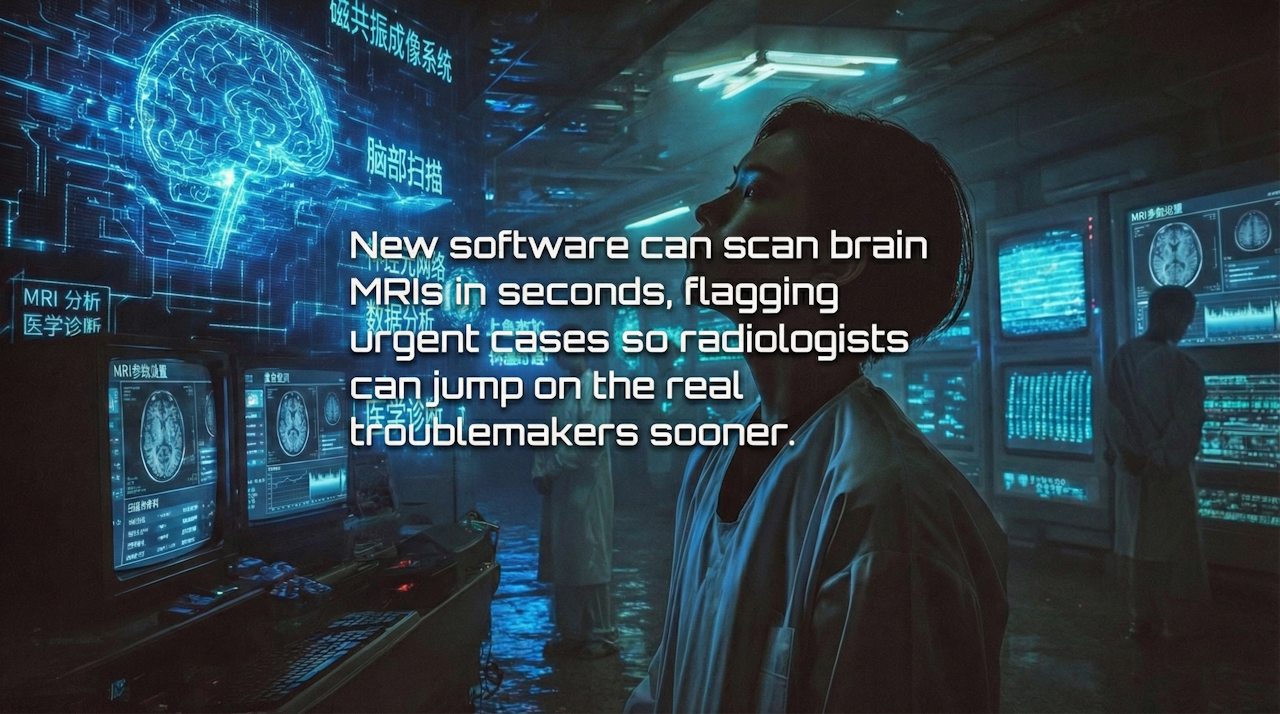
That’s the framing behind a new deep-learning tool reported this week, described in a ScienceDaily write-up. The researchers’ core claim is operational rather than magical: the model can analyse a completed brain MRI exam quickly and flag studies that may contain urgent abnormalities, allowing clinicians to review those first.
In other words, the value isn’t that the AI “reads” like a human. It’s that it helps decide what should be read next.
What the model is (and isn’t) trying to do
The study centres on a triage algorithm designed to detect “urgent findings” on brain MRI and assign a priority score. Public summaries describe it as scanning “in seconds”, which may be feasible for modern inference on optimised hardware, but the clinically meaningful measure is end‑to‑end time saved in the reporting workflow—not just compute time. The ScienceDaily report positions the tool as a prioritisation layer that sits after image acquisition and before a final report is issued, rather than as an autonomous diagnostic system.
Crucially, triage tools live and die by their scope. Rather than attempting to label every possible diagnosis, they target a narrower set of high‑risk patterns likely to need quick escalation (for example, haemorrhage, mass effect or hydrocephalus—exact categories and definitions are outlined in the paper). Constraining the task is how developers aim for higher sensitivity on the events that matter most in the short term.
The institutional release from the University of Rochester Medical Center describes the intent as helping radiologists “jump” urgent cases in the list, not replacing radiologist interpretation or clinical judgement. That distinction matters because safety risks differ: a triage miss could delay care, while over-flagging could create noise and erode trust.
Evidence so far: performance, validation and the workflow claim
The headline “in seconds” is attention‑grabbing, but the more important question is how reliably the AI separates truly urgent scans from routine ones—across different scanners, hospitals and patient groups. The team evaluated the model’s ability to identify urgent findings and tested it on validation cohorts; they report quantitative performance metrics (such as AUC, sensitivity and specificity) and discuss limitations typical of retrospective studies.
Coverage focuses on the workflow implication: by pushing likely-urgent exams up the queue, the system could reduce time-to-review for critical patients. That is a reasonable hypothesis, and some hospitals already use algorithmic prioritisation for certain CT and chest imaging workflows. However, faster flagging only translates to faster care if the department has capacity to act on the flags (radiologist availability, escalation pathways, after-hours staffing, and so on). In a saturated system, triage may still help, but it can also shift delays downstream.
The paper is also accompanied by an editorial that highlights real-world pitfalls: spectrum bias, data drift, and the danger of over‑reliance on automated prioritisation when the model’s blind spots aren’t fully understood. Editorials are opinion pieces, but they can be useful for surfacing “what could go wrong” scenarios that the main paper may not emphasise.
Safety questions: false alarms, missed emergencies and human factors
Any triage system creates two broad kinds of harm: it can miss an emergency (false negative), or it can generate an unnecessary alert (false positive). A missed haemorrhage is the nightmare scenario; too many false alarms can be more subtle but still harmful, because clinicians may start ignoring the system, or routine cases may be repeatedly de-prioritised. The report above specifically raises human factors risks, including the possibility of automation bias—people placing more weight on the algorithm’s ranking than is warranted.
Then there’s the messy reality of MRI itself. Artefacts, motion, post‑operative anatomy, and unusual presentations can all confound pattern-recognition systems. A tool may perform strongly on the population it was trained on yet struggle with edge cases, such as paediatric patients, rare tumours, atypical infections, or patients with implants. The study provides a snapshot of performance under specific conditions; it does not guarantee identical results in every hospital.
That’s why a triage model’s “seconds” advantage should be judged alongside its governance: what happens when the algorithm is uncertain, how uncertainty is communicated, and whether clinicians can easily audit why a scan was flagged. Without transparency and feedback loops, speed can become a brittle virtue.
From research to radiology departments: regulation and rollout
Whether and how such software is deployed depends on regulatory classification and intended use. In Australia, AI tools used for diagnosis or to inform clinical decisions can fall under “software as a medical device”, subject to oversight by the Therapeutic Goods Administration. The TGA’s overview of software as a medical device (SaMD) and its more detailed guidance on regulating software-based medical devices outline risk-based obligations, including evidence expectations and post‑market monitoring. Internationally, frameworks from groups such as the IMDRF are often referenced for common terminology and risk concepts, though local requirements still apply.
Even once cleared, deployment is not plug-and-play. Hospitals typically need integration with PACS and RIS worklists, cybersecurity review, model monitoring, and agreed escalation protocols—who gets notified, how quickly, and what “urgent” means in practice. Procurement decisions also hinge on whether the tool improves measurable outcomes, such as time to report, time to treatment, length of stay, or morbidity—metrics that can be harder to demonstrate than algorithmic accuracy alone.
There is also an equity consideration. If the training data under-represents certain demographics or scanner types, performance may vary across settings. Independent replication across diverse sites is usually an important next step before broad clinical confidence.
Where AI triage fits in a strained system
AI triage is, at heart, a workflow technology—aimed at making scarce expertise go further. That makes it attractive in 2026, as imaging volumes rise and clinician burnout remains a persistent challenge. But it also means success should be judged by system outcomes, not just model metrics: does it reliably shorten the time to escalate a truly urgent patient without overwhelming staff with false alerts or introducing new failure modes?
The current evidence suggests this brain MRI triage model can rapidly analyse exams and identify studies likely to contain urgent abnormalities, at least within the tested settings. Coverage similarly frames it as a prioritisation aid rather than a replacement for clinical reporting.
The neutral bottom line: AI appears to be improving at sorting radiology worklists. Whether that translates into consistently faster care for the sickest patients will depend less on how quickly the model runs, and more on how safely it is integrated into the real constraints of hospital work.